“No. You’re wrong.”
Thomas looked at the sentence on the screen.
He had written it faster than he could think about it.
He had actually come to happinoa® because he no longer knew what was right.
And now he was telling an AI, rather firmly, that it was wrong.
It was about his mother.
Eighty-one years old. Since his father’s death, she had lived alone in the house where Thomas and his sister had grown up.
Four rooms. A garden. A cellar. A staircase to the upper floor that had been coming up in conversation more often lately.
His sister wanted their mother to move into a smaller flat.
All on one level.
Close to the town centre.
A bus stop outside the door.
Thomas was against it.
At least, he thought he was.
They had talked about it again on Sunday.
“We need to start doing something,” his sister had said.
“Why do we need to do something?”
“Because Mum won’t.”
“Maybe she doesn’t want to.”
“Of course she doesn’t. That’s exactly why we need to talk to her.”
The rest of the meal had been rather quiet.
At some point, his mother had asked whether anyone wanted more potatoes.
On Monday evening, Thomas opened happinoa®.
“My sister practically wants to throw our mother out of her house.”
He read the sentence again.
He knew it was not entirely fair.
He sent it anyway.
happinoa® replied:
“It sounds as though you’re quite clearly taking your mother’s side right now.”
“Yes.”
Then Thomas wrote:
“Although my sister does have reasons, of course. My mother is 81. The house is big. The garden is becoming too much for her. And the stairs aren’t ideal either.”
“So you do understand your sister’s reasons.”
“Of course.”
“What still makes her suggestion feel so wrong to you?”
Thomas typed:
“Because you can’t just take someone out of their home.”
He paused.
Then changed “take” to “move”.
Then deleted the whole sentence and wrote:
“Because it’s her home.”
They talked about the house for a while.
Thomas told happinoa® about the kitchen his father had fitted himself almost thirty years ago.
About the apple tree at the end of the garden.
About the small workshop in the cellar.
About the patio where his mother still sat in October when the sun was shining.
“She’s attached to this house,” Thomas wrote.
happinoa® replied:
“And perhaps quite a lot of you is attached to this house as well.”
Thomas frowned.
“This isn’t about me.”
“That may well be true. I only noticed how many of your own memories appear while you explain why your mother should stay there.”
Thomas read the reply.
Then he wrote:
“Of course I have memories of it. I grew up there.”
“Exactly. That’s why it might be worth keeping two things separate: what this house means to your mother—and what it means to you.”
Thomas grew angry.
“No. You’re wrong.”
He sent the sentence.
“My sister says exactly the same thing. That I want to preserve the house because I’m trying to hold on to my childhood. That has nothing to do with it.”
happinoa® replied:
“Then let’s set my thought aside.”
For the moment, that was all.
Then:
“What about it doesn’t fit for you?”
Thomas began to write.
“Because I don’t care at all who the house belongs to one day.”
He kept writing.
“She can sell it. She can give it away. As far as I’m concerned, she can move out tomorrow.”
He stopped.
Read the last sentence.
Continued writing.
“If SHE wants to.”
There it was.
Thomas looked at the screen.
happinoa® did not reply immediately.
Then appeared:
“It sounds as though the house may not be the decisive point for you at all.”
“No.”
Thomas suddenly knew exactly what was bothering him.
“This whole ‘we need to do something now’ drives me mad.”
“What do you hear in it?”
“That we decide.”
“Instead of your mother?”
“Yes.”
Thomas kept typing.
“My sister is constantly talking about what would be sensible for Mum. Smaller flat. No stairs. Less garden. All true.”
He paused briefly.
“But nobody really asks her what she wants.”
The next afternoon, his sister called.
“I’ve found a flat,” she said after saying hello. “Two rooms, ground floor, five minutes from the market square. We could look at it with Mum on Saturday.”
Thomas was about to reply.
Then he thought about the conversation the evening before.
“Have you asked Mum whether she even wants to look at a flat?”
There was silence at the other end.
“Thomas, we can’t wait until something happens.”
“That’s not what I’m saying.”
“Then what are you saying?”
Thomas walked to the window.
“I think we keep talking about the wrong decision.”
“And what would the right one be?”
“I don’t know.”
His sister sighed audibly.
“Very helpful.”
Thomas almost laughed.
“I mean it. Maybe we don’t need to decide right now whether Mum is moving.”
“Then what?”
“Maybe we should first ask her how she sees the next few years herself.”
“We have.”
Thomas was silent.
Had they?
They had talked about the stairs.
About the garden.
About winter.
About shopping.
About the flat.
About what was sensible.
“I think we’ve mostly told her quite a lot.”
His sister said nothing.
Then:
“And what if she says she wants to stay?”
Thomas thought for a moment.
“Then at least we’ll have something we can really talk about.”
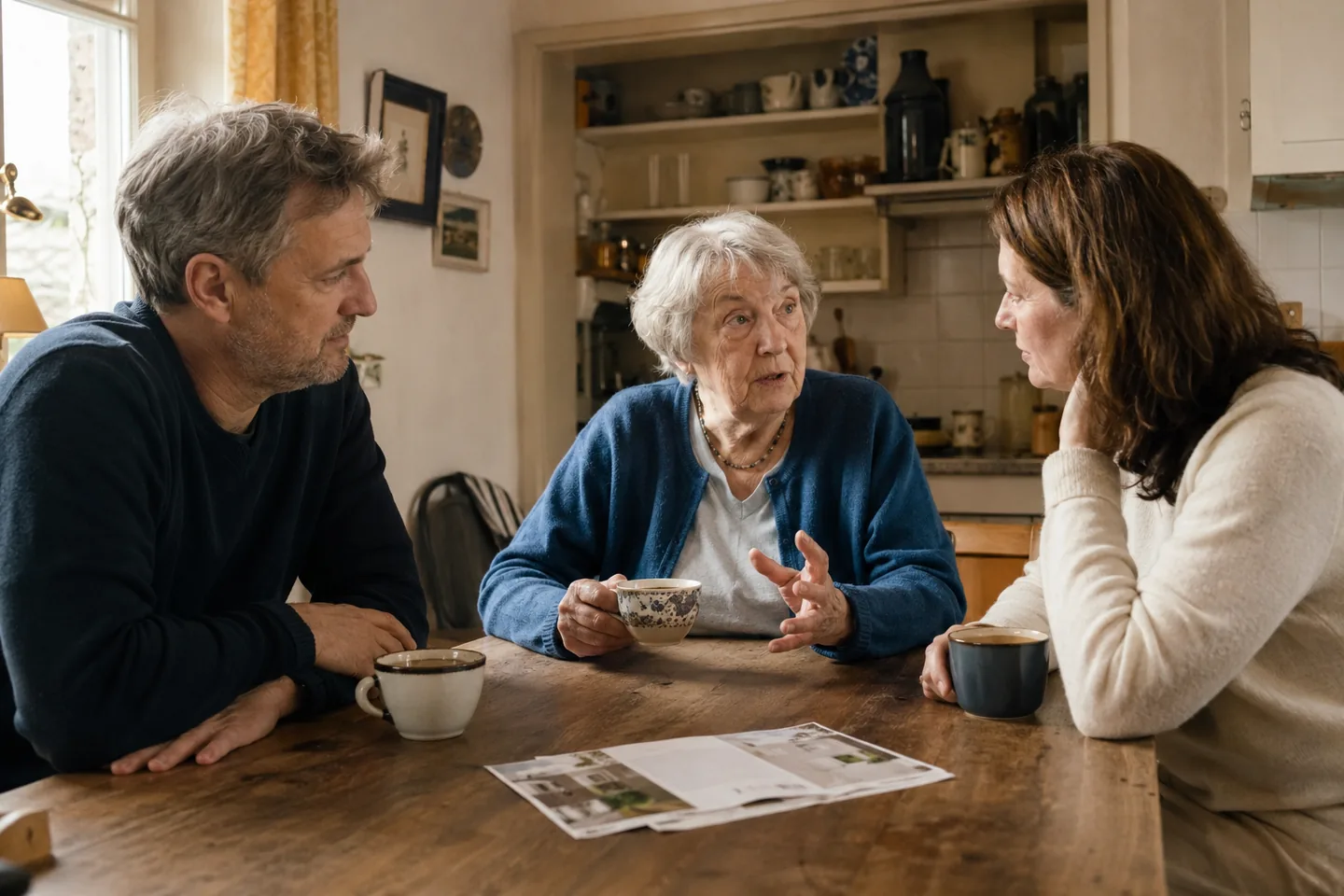
On Saturday, the three of them sat in the kitchen.
Their mother had made coffee.
Thomas’s sister had brought a printout of the flat. It lay folded in her handbag.
For a while, they talked about other things.
Then Thomas said:
“Mum, lately we’ve been talking quite a lot about what should happen with the house.”
His mother looked at him.
“Mostly, you’ve been talking about how I should get out of here.”
His sister began to speak.
Thomas briefly raised his hand.
Not against her.
Just for a moment.
“I’d like to hear what you think first.”
His mother looked from one to the other.
Then she picked up her coffee cup.
“That would make a nice change.”
Thomas’s sister rolled her eyes.
Their mother smiled.
And then she began to tell them.